
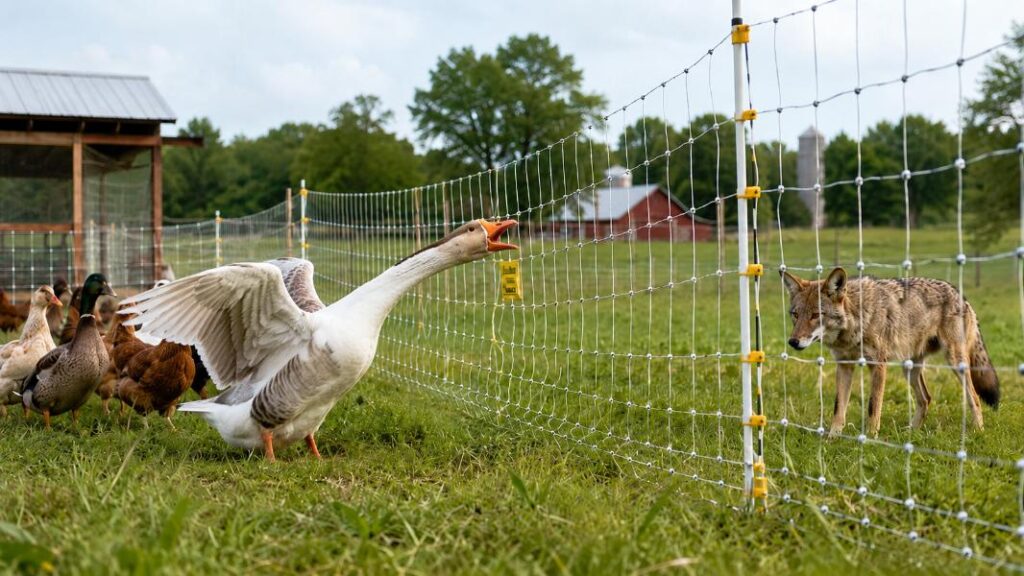

Electric poultry fencing is one of the most flexible ways to give chickens, ducks, geese, and other poultry access to grass while adding an important layer of protection against ground predators.
Unlike a permanent chicken run, electric poultry netting can be installed relatively quickly, moved to new areas, expanded with additional sections, and packed away when it is no longer needed. This makes it especially useful for farms and homesteads that rotate their birds through different pastures.
After using electric fencing with poultry on our farm, our top recommendation is the Premier 1 PoultryNet 12/48/3 electric netting in the 48-inch-tall, 164-foot-long, double-spike configuration.
The fence itself is only one part of a reliable setup. The energizer, support posts, ground stakes, voltage indicator, vegetation control, and repair supplies are all important. Here is the complete setup we recommend.
Premier 1 Supplies makes quality electric fencing products, and its 48-inch PoultryNet is our preferred option for chickens and other poultry.
The version we recommend is:
48 inches tall
164 feet long
Double-spike posts
Electrified poultry netting
Designed for chickens, ducks, geese, turkeys, and other poultry
Premier 1 describes the 48-inch net as suitable for active or flighty birds. A 164-foot roll weighs approximately 23 pounds and arrives with the line posts already incorporated into the netting. The company also notes that the taller net is more likely to discourage larger ground predators, including coyotes and dogs.
We prefer the double-spike version because it provides better stability than a single-spike post, particularly on uneven, soft, or damp ground. The second spike helps prevent the posts from twisting and makes it easier to keep the fence standing straight.
The full 164-foot length also provides enough fencing to create a useful grazing area without immediately needing to connect multiple rolls.
Electric poultry netting creates both a physical and psychological barrier.
The mesh helps contain poultry, while the electrical pulse discourages animals from pushing, climbing, or nosing through the fence. This can be useful for deterring dogs, coyotes, raccoons, foxes, and other ground-level threats.
The fence should not be treated as a guarantee against every predator. It does not cover the top of the enclosure, and its effectiveness depends on proper installation, grounding, voltage, vegetation control, and maintenance.
We consider electric netting one part of a larger poultry protection system. Birds should still have a secure coop or shelter, particularly at night.
An electric poultry fence must be connected to a properly sized energizer. Your location and how often you plan to move the fence will determine whether a plug-in or solar energizer is the better choice.
A plug-in energizer is usually the best choice when:
The fence is close to an electrical outlet
The enclosure will remain in approximately the same location
You want the most consistent power supply
Your area experiences long periods of cloudy winter weather
Moving the energizer frequently is not important
For a semi-permanent poultry enclosure near a barn, house, garage, or other powered structure, we generally prefer a plug-in energizer.
It eliminates the need to monitor a solar battery’s charge level and is less affected by extended periods of overcast weather.
Premier 1 recommends plugging an AC energizer directly into a suitable 110-volt outlet rather than using an extension cord. An extension cord can reduce voltage and expose electrical components to weather.
A solar energizer is a better option when:
The fence is far away from electrical power
The enclosure will be moved frequently
You are rotating poultry between pasture areas
Running permanent electrical service is impractical
Portability is more important than maximum convenience
Solar energizers allow you to establish poultry areas in remote parts of a property without running a long electrical line.
The main disadvantage is battery maintenance, particularly during winter.
During extended periods of dark or overcast weather, a solar unit may not receive enough sunlight to keep its battery fully charged. We have found that solar units sometimes need to be brought inside and manually charged during the winter.
Premier 1 recommends checking solar and battery energizers regularly during cold weather. The company also says the solar panel should face south and remain fully exposed to sunlight without shade from grass, trees, fence posts, or buildings.
For a remote or regularly moved fence, the additional maintenance may be worthwhile. For a fixed enclosure located close to power, a plug-in energizer is usually the simpler choice.
Do not rely entirely on the posts built into the poultry netting.
We recommend ordering additional 48-inch FiberTuff support posts with the fence. These posts can be installed at corners, ends, gates, curves, and other points where the netting needs more support.
Premier 1 specifically recommends its FiberTuff posts for the ends, corners, and major directional changes of electrified net fencing.
Extra support posts help:
Keep corners upright
Reduce sagging
Maintain tension along the top of the net
Support areas with uneven ground
Prevent the fence from leaning after wind or rain
Create cleaner directional changes
A sagging fence is more likely to contact vegetation or the ground, which can reduce voltage. It may also create gaps that invite poultry or predators to investigate.
Support posts are a relatively inexpensive addition that can make the entire installation more reliable.
Even when the main fence posts are installed correctly, gaps can develop between the bottom of the netting and the ground.
This is especially common on:
Uneven terrain
Small dips in the ground
Slopes
Areas with loose soil
Sections between widely spaced posts
Animals frequently explore the bottom edge of a fence. Chickens may scratch beside it, ducks may push against it, and predators may attempt to nose underneath it.
We use 9-inch plastic tent stakes between the main fence posts to keep the bottom of the netting close to the ground.
The recommended Hikemax package includes 30 lightweight, weather-resistant ABS plastic stakes.
Place the stakes wherever the fence begins to lift or where there is a noticeable gap. Because the stakes are plastic, they can secure the bottom without introducing a conductive metal object against the electrified netting.
Do not pull the netting so tightly against the ground that the electrified strands remain in constant contact with soil, wet grass, or other vegetation. The goal is to close obvious gaps while keeping the conductive parts of the fence clear.
One of the biggest risks with electric poultry fencing is assuming that the fence is working when it is not.
A disconnected wire, drained battery, broken strand, grounding problem, fallen branch, or heavy vegetation can reduce or eliminate the electrical pulse.
We recommend attaching a live electric fence indicator directly to the fence. The indicator flashes with the energizer pulse, providing a quick visual confirmation that the fence is receiving power.
The LED indicator we use clips to electric fence wire or tape and is designed to detect energizer pulses across a range of approximately 300 volts to 10,000 volts.
Install the indicator somewhere that is easy to see during daily chores. A flashing light makes it possible to confirm at a glance that the fence is energized.
However, an indicator light should not completely replace periodic voltage testing. A dedicated fence tester gives you an actual voltage reading and can help identify a fence that is technically energized but operating at a weak level.
Premier 1 uses 5,000 volts as an important troubleshooting reference point for its fencing systems. If the energizer tests strongly but the connected fence does not, the problem is usually somewhere along the fence line.
Order two electric netting repair kits at the same time you order the fence.
Do not wait until the netting is damaged.
Electric poultry netting can be cut or broken by:
Falling branches
Mowers and weed trimmers
Farm equipment
Animals becoming tangled
Accidental cuts
Repeated bending or abrasion
Improper storage
A small break can prevent part of the fence from conducting electricity correctly. It may also create an opening large enough for poultry to escape or a predator to enter.
Premier 1 sells repair components and patch sections made for its electric net fencing. Its patch sections can be used to repair a damaged area, close a gap, or add a short section of compatible fence.
We recommend purchasing two kits because damage often happens at the least convenient time. Keeping extra repair materials on the farm allows you to restore the fence immediately rather than leaving the enclosure unprotected while waiting for replacement parts.
Store the repair kits in a labeled container near your fence tester, energizer accessories, and other poultry supplies.
Electric netting works best when installed over a reasonably clear fence line.
Before setting up the fence:
Mow or trim the intended path.
Remove fallen branches, sticks, wire, and debris.
Identify low areas and major changes in elevation.
Decide where the gate or entrance will be located.
Plan corners so that additional support posts can be installed.
Choose a safe, dry location for the energizer.
Install the grounding system according to the energizer manufacturer’s instructions.
Vegetation touching the conductive strands can pull voltage away from the fence. Wet grass and weeds can create an especially heavy electrical load.
Premier 1 lists conductors touching the soil, another wire, or a metal post among the common causes of reduced fence voltage.
Keeping a narrow strip beneath the fence trimmed will improve performance and make future inspections easier.
Start with the energizer turned off and disconnected.
Unroll the netting along the planned fence line. Install the built-in posts one at a time, keeping the net upright and avoiding unnecessary twists.
Once the basic shape is established:
Adjust the post spacing.
Install additional support posts at corners and major turns.
Use plastic tent stakes to secure gaps along the bottom.
Make sure conductive strands are not touching metal, soil, branches, or heavy vegetation.
Connect multiple rolls using the manufacturer’s approved connectors.
Connect the fence lead and grounding system.
Turn on the energizer.
Test the voltage at several points around the enclosure.
Confirm that the live fence indicator is flashing.
Walk the entire perimeter before placing birds inside. Look for sagging sections, crossed wires, ground contact, loose connections, and areas where an animal could push underneath.
An electric poultry fence requires regular observation, but maintenance is usually straightforward.
During daily animal chores:
Look at the live fence indicator.
Check for leaning or fallen posts.
Look for branches resting on the net.
Inspect the bottom for newly created gaps.
Confirm that no bird is caught in the netting.
Check the energizer and solar panel when applicable.
At least once a week:
Test the voltage with a proper fence tester.
Trim grass and weeds beneath the fence.
Inspect corners and support posts.
Check all electrical connections.
Examine the net for broken strands.
Inspect the grounding system.
Check the solar battery charge when using a solar energizer.
Storms, wind, falling branches, rapidly growing grass, and animal activity may require more frequent inspections.
A shorter fence may work for calm or heavy birds, but it provides less containment for active chickens and less of a barrier for larger predators. We prefer the 48-inch height for a more versatile poultry setup.
Built-in fence posts alone may not keep the net properly tensioned around corners, curves, or uneven areas.
Heavy vegetation can reduce fence performance. Keep the fence line trimmed.
A light on the energizer confirms that the energizer is operating. It does not necessarily confirm that adequate voltage is reaching the entire fence.
Short days and extended cloud cover can gradually drain the battery. Check it regularly and manually recharge it when necessary.
A repair kit is most valuable when it is already on the farm before damage occurs.
Use plastic tent stakes wherever the ground dips between posts. Small gaps can quickly become larger once birds begin scratching or animals begin investigating them.
For a complete setup, we recommend ordering:
Premier 1 PoultryNet 12/48/3
48-inch height
164-foot length
Double-spike configuration
Properly sized plug-in or solar energizer
Ground rods and energizer connection hardware
Additional 48-inch support posts
Plastic tent stakes
Live fence pulse indicator
Digital or multi-light voltage tester
Two electric netting repair kits
Approved fence connectors
Gate, if you want a more convenient permanent entrance
Purchasing the complete setup at the beginning costs more than buying only the netting, but it reduces sagging, electrical problems, emergency repairs, and weak areas along the bottom.
Our preferred option is the Premier 1 PoultryNet 12/48/3 in the 48-inch-tall, 164-foot-long, double-spike configuration. It provides a useful balance of height, enclosed area, portability, and stability.
A plug-in energizer is generally better for a fence that is close to power and will not move frequently. A solar energizer is better for remote locations and rotational grazing systems.
It can, but performance depends on available sunlight, panel placement, battery condition, fence load, and local weather. Extended overcast periods may require the unit to be brought inside and manually charged.
Plastic tent stakes help close gaps between built-in fence posts. They are particularly useful over uneven ground and help prevent poultry or predators from nosing underneath the net.
Connect a live fence indicator for quick visual confirmation and use a proper voltage tester for regular measurements. Check the fence immediately if the indicator stops flashing or the voltage drops.
No fence system can guarantee complete protection. Properly installed and maintained electric netting can provide a strong deterrent against many ground predators, but it does not cover the top of the enclosure and should be combined with a secure nighttime shelter and regular inspections.
For most farms and homesteads, the best electric fence for chickens is not simply a roll of netting. It is a complete system.
Our recommended setup starts with the Premier 1 48-inch by 164-foot double-spike PoultryNet. Add the correct energizer, extra support posts, plastic tent stakes, a connected live fence indicator, a proper voltage tester, and two repair kits.
Choose a plug-in energizer when reliable power is nearby and the fence will remain in place. Choose solar when portability and remote placement are more important, but be prepared to monitor and manually recharge the battery during long periods of cloudy winter weather.
Taking the time to support the fence, close bottom gaps, control vegetation, confirm voltage, and keep repair materials ready will make the system much more dependable.